
Compliance, Standards, and Operating Controls
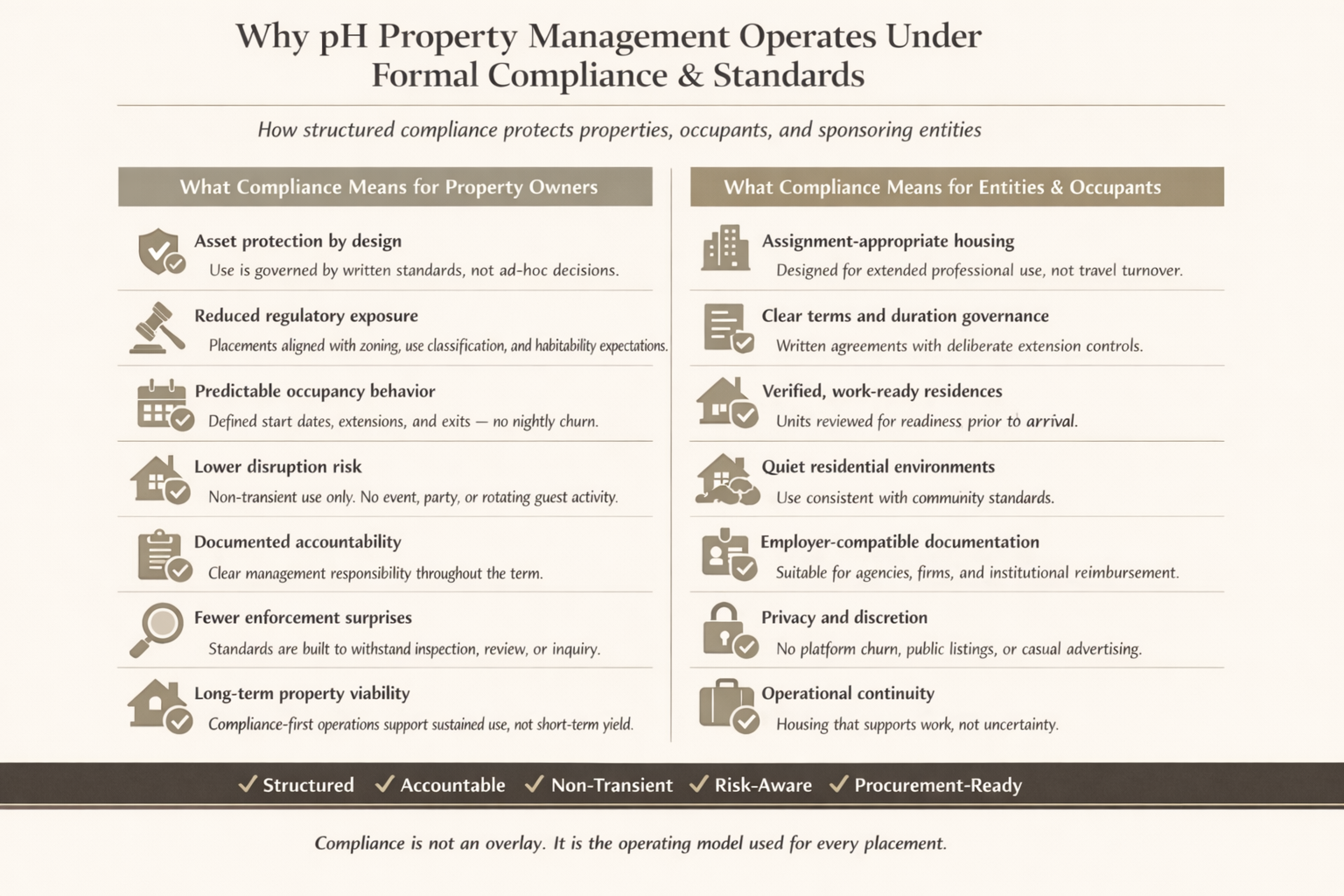
pH Property Management provides assignment-based housing operated under defined standards appropriate for government, institutional, and professional use. Residences are administered with documented terms, controlled occupancy parameters, and governance practices designed to support predictable assignments, accountability, and non-transient residential occupancy.
These standards are published intentionally to establish clear expectations and alignment among property owners, occupants, and sponsoring entities, and to support consistent, defensible placement decisions.
Regulatory Alignment
Operations are conducted in alignment with applicable federal, state, and local housing requirements, including fair housing obligations, zoning and use classifications, and health and safety standards. Properties are reviewed for suitability and compliance prior to placement and are subject to ongoing oversight during occupancy.
Use Classification
Residences are classified for assignment-based, non-transient residential use only. Occupancy is subject to minimum stay requirements and is restricted to approved residential living connected to documented professional or institutional assignments. Short-term, transient, or vacation use is not permitted.
Placement Review and Occupancy Approval
All occupancy is subject to a pre-placement review aligned with the nature of the assignment. Review may include identity verification, confirmation of assignment or sponsorship, duration validation, and verification of occupancy limits. This process is intended to prevent misuse, ensure appropriate placement, and preserve residential integrity.
Property Readiness Standards
Prior to placement, each residence is reviewed to confirm baseline readiness for assignment-based occupancy. Review includes cleanliness, suitability of furnishings for extended stays, functional utilities, and appropriateness for quiet residential use. Properties that do not meet these minimum standards are not approved for placement.
Maintenance and Issue Resolution
Maintenance and issue resolution follow documented reporting and response protocols. Safety-related matters are prioritized, while routine maintenance is addressed within defined timeframes. Informal, ad hoc, or undocumented maintenance practices are not permitted.
Privacy, Discretion and Data Handling
Privacy and discretion are core operational principles and apply to both occupant placement and property management. Placements are conducted deliberately, with consideration for property suitability, surrounding residential context, and the nature of the assignment. Occupant and property information is collected solely as required for placement and ongoing management, is not sold or repurposed for marketing, and is handled in a controlled manner. Residences are not positioned, advertised, or operated as short-term or transient housing.
Duration and Extension Governance
All placements are established for a defined duration under documented terms. Extensions are not automatic and require formal review prior to approval. Extensions exceeding established thresholds are subject to additional terms and conditions, which may include reassessment of pricing, use classification, and operational considerations.
Financial Terms and Transparency
Financial expectations are established through written placement terms. Rates, inclusions, and applicable limits are documented in advance, including disclosed utility caps and service parameters where relevant. Billing and payment requirements are defined prior to occupancy to ensure clarity and accountability.
Operational Governance Framework
All placements operate under defined use classifications, documented terms, and controlled occupancy parameters. Duration, extensions, and use are actively managed to preserve program alignment, placement suitability, and operational consistency.
Scope and Limitations
The Company does not provide legal advice or make regulatory determinations. Published standards reflect internal operating policy and may be modified based on jurisdictional requirements, property-specific constraints, or changes in applicable regulations.